 piledrivegames.
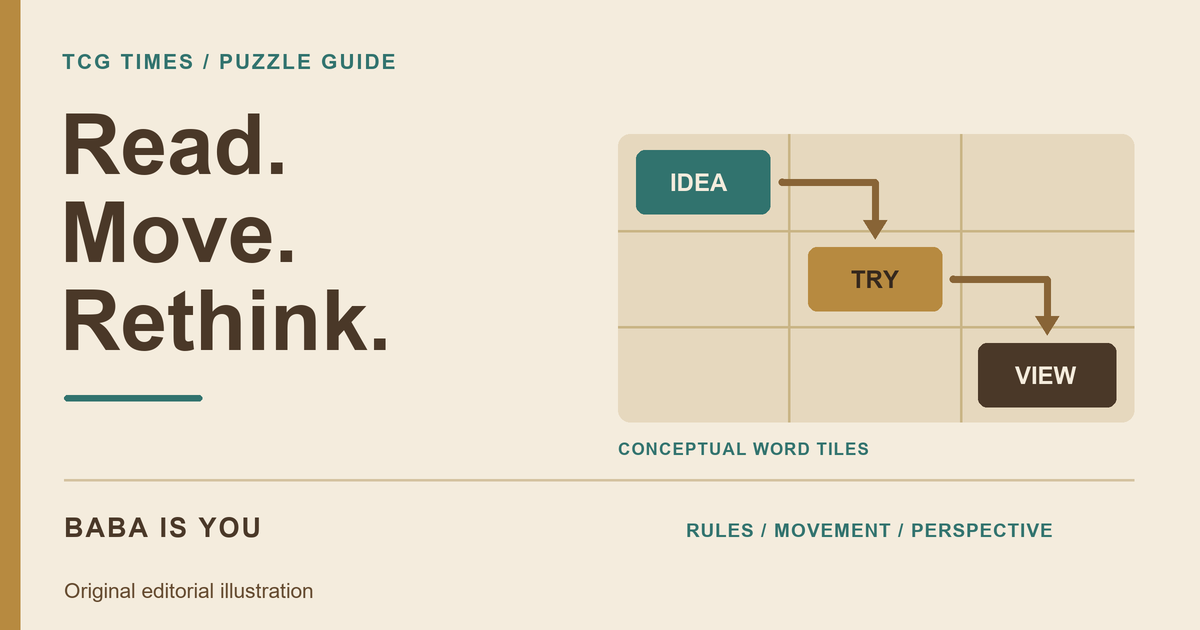
Baba Is You is a puzzle game in which the rules are part of the level. They appear as physical blocks you can interact with, so solving a problem can involve changing how the world works as well as moving through it.
The Steam listing identifies it as a single-player game from Hempuli Oy, originally released on March 13, 2019. This starting guide explains its central idea and offers a way to approach unfamiliar puzzles without giving a sequence of moves for a particular level.
What makes Baba Is You's rule blocks different?
On the official developer page, the key idea is that rules exist as objects inside the world. Moving them can change the behavior of things around you. The instructions and the space you are navigating become connected parts of the problem.
Steam's description gives examples of the range: changing the form you control, altering an object's properties and changing the goal itself. These are possibilities to investigate, rather than a promise that any one change will solve the level in front of you.
That suggests a useful habit: whenever you move a rule block, pause to read what the rules now say. A move can matter because of its position in a sentence, its position in the room, or both. Looking only at the object's new location can miss the more important change.
What should you look at before making a move?
Begin by describing the current situation in your own words. Separate what the visible rules establish from what you merely expect because of the way an object looks.
| Question | What to examine |
|---|---|
| What can I control? | Read the active rules, then compare them with the objects that respond. |
| What is preventing progress? | Look at both the room's layout and the rules affecting the obstacle. |
| Which words can I reach? | Consider the space needed to approach and reposition a block. |
| What would count as success? | Check the present goal instead of assuming it must remain unchanged. |
The purpose is to make your next experiment specific. “Can I change this obstacle's behavior?” is easier to investigate than pushing pieces around without deciding what you want to learn.
How can you experiment without needing a walkthrough?
Choose one idea and predict what you think it will change. Where the level permits it, test a small adjustment before committing to a longer sequence. Then compare the result with your prediction.
- Read again after the change. Check which rules still apply and which have been altered.
- Notice access as well as meaning. An interesting arrangement may still require room to reach the pieces.
- Keep observations separate from guesses. A failed attempt can still answer a useful question.
- Revisit assumptions. If the same plan keeps failing, reconsider the role you assigned to an object or the goal you chose.
These are general puzzle-solving suggestions, not tested solutions or a claim that every level follows the same pattern. If you decide to use help, try a small hint about the mechanic first, then return to the puzzle before reading a complete solution.
How much puzzle content is there?
Steam describes more than 200 levels. Read that as the listing's broad scope statement, not an exact count of every level added through updates or shared content.
There is also an official level editor. Hempuli's 2021 editor announcement describes tutorials, online sharing and a Featured Levels list. A later January 2026 update documents search in Play Levels and Play Levelpacks. Those are useful options to investigate after getting familiar with the main game.
Online level sharing is a way to find puzzles; it does not establish simultaneous multiplayer. Use the game's own sharing tools and current developer information rather than assuming a separate Workshop feature.
What should Steam players check before starting?
Read the current store requirements, language information and input options for your setup. Hardware requirements and the Steam client's supported operating systems are separate checks, especially when an older game lists an older operating system.
The more useful question about the experience is whether you enjoy changing a hypothesis and observing the result. Simple-looking pieces can still leave room for a demanding reasoning problem. You can give yourself time to examine one interaction instead of measuring progress only by the number of completed levels.
Is this the kind of problem-solving you want?
Baba Is You's central attraction is being able to question the rules as part of solving the room. Look at ordinary gameplay to see that relationship between language, space and consequence before choosing it.
For another guide involving puzzles alongside exploration, see our Endacopia introduction, which also explains its horror context. Our Neon White guide looks at a different kind of experimentation: learning movement choices and routes under a timer. These games ask different things of the player, so compare the activities that appeal to you.