 piledrivegames.
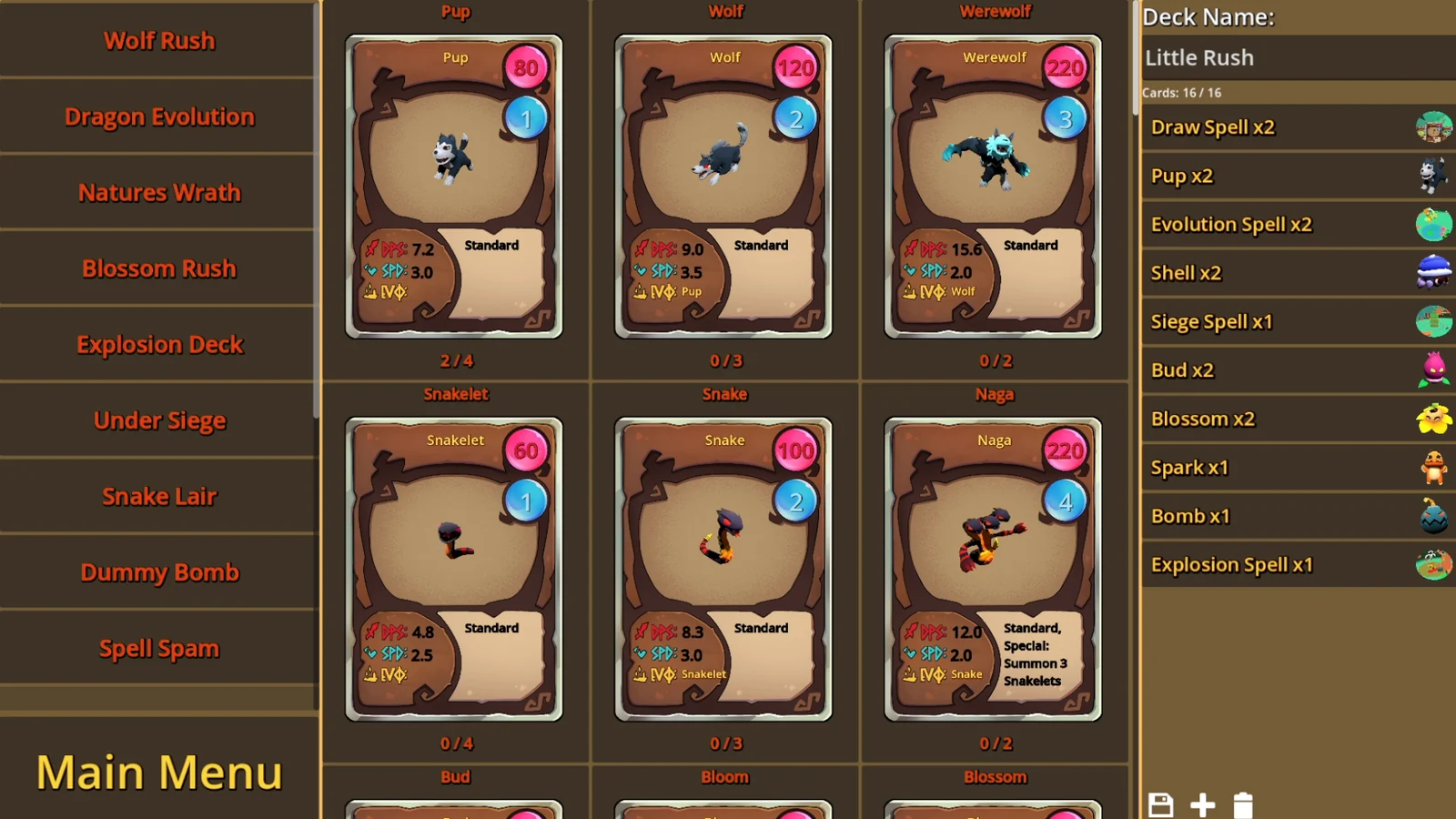
A strategy game should challenge your decisions. Understanding what a card does should not be the difficult part.
That distinction matters when you are building an indie game as a solo developer. It is tempting to keep adding monsters, spells and modes. Every new mechanic also adds something that the player has to understand, and something that you have to explain, test and maintain.
Start with the decision, then build the feature
Pixel Rush: RTS combines deck building with real-time battles in Godot. A card can summon a creature, evolve one already in play, or cast a spell. The player has to weigh that action against a limited mana supply while the battle keeps moving.
That gives a feature a useful test: does it introduce a different decision? Another creature with larger numbers is easy to describe, but a creature with a different movement behaviour can change how a deck works. The extra complexity earns its place only if the player can recognise and use that difference.
Keep the card and the game in agreement
Health, cost and attack information need a dependable source. If one number changes in the game while an old number remains on a card or a wiki page, players end up planning around rules that no longer exist.
In a data-driven card system, a stable card ID connects the creature to its stats and presentation. The display name can change without changing that identity. This is especially useful when two cards have similar names or when an evolution belongs to a larger family.
The Pixel Rush: RTS field guide makes those relationships visible. Compare the cost, health, speed and basic attack DPS, then look at the ability and evolution path. DPS alone does not capture summons, special attacks or how long a creature spends reaching its target.
Let the player hear what happened
The October development update focused on music and sound effects. Drawing a card, evolving a monster and casting a spell now have audible feedback. The campaign music also changes as the player moves between biomes.
Audio can help explain an event without adding another message to the screen. It still needs restraint. If every effect demands attention, the important moment becomes harder to hear. A small card sound and a creature’s battle cry serve different purposes.
This is part of making a game feel responsive: the player acts, the game responds, and the result is understandable.
Use Godot’s building blocks to keep work manageable
Godot’s scenes and signals give developers ways to separate reusable pieces and communicate between them. The official signals tutorial is a useful starting point if you are learning how an event in one object can notify another.
For a small project, the practical benefit is being able to change a presentation detail without rebuilding the whole game around it. Keep responsibilities clear: the combat rules decide what happened, and the interface communicates that result. The same care should apply to a monster card, a health display and a victory screen.
Playtest the explanation as well as the combat
A successful playtest is not just a match that finishes without crashing. Watch whether a player understands where to place a creature, what an evolution requires, and why a spell did or did not help.
Write down the confusing moment before adding another tutorial panel. Sometimes the better fix is a clearer label, a stronger visual cue, or a sound that arrives at the right time. Sometimes the mechanic itself needs to become simpler.
If you want to see how these choices come together, try the Pixel Rush: RTS browser alpha. The game is also heading to Steam Next Fest in February 2027. There is still work to do, and that is exactly why feedback before release matters.