 piledrivegames.
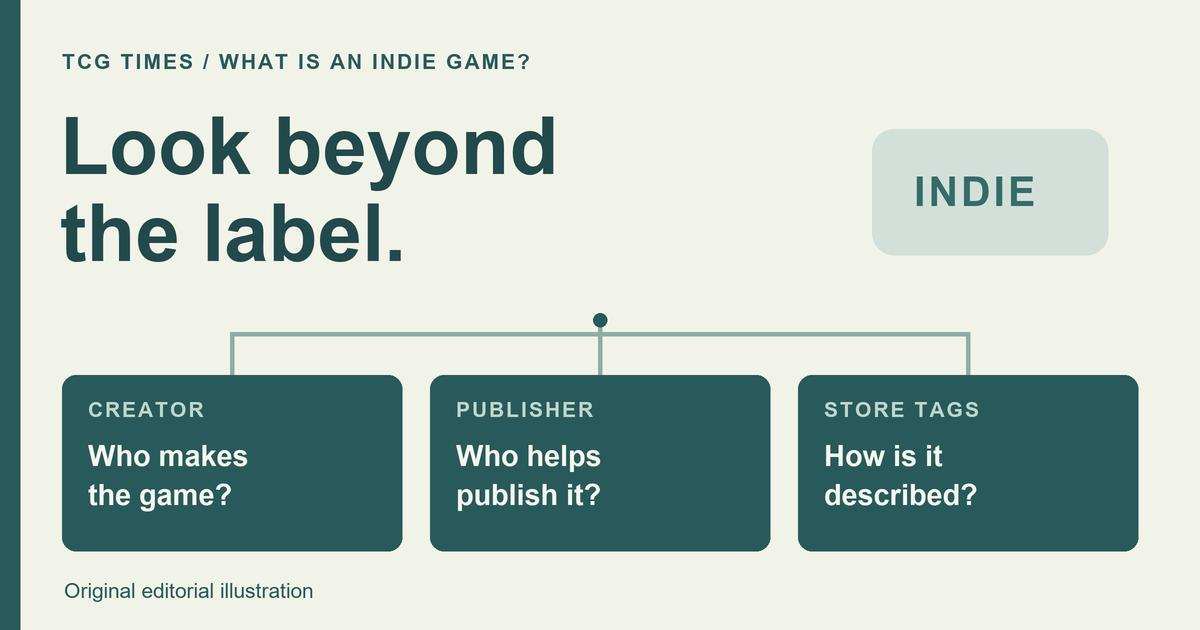
An indie game is an independently developed game. The label concerns how a game is made and the independence behind it. It does not, by itself, tell you whether you will be playing a platformer, a strategy game or a puzzle adventure.
The difficult part is deciding what independence means in a particular conversation. A festival, an awards category and a Steam tag can use the word for different purposes. Here is how to read those labels without reducing every game to its team size, artwork or publisher name.
What does indie mean in games?
Indie is short for independent. A useful starting point is to ask who is developing the game, how its production is supported and which definition the speaker is using. Treat those as separate questions rather than expecting one visual clue to answer all three.
For example, The Game Awards' Best Independent Game category describes work produced outside the traditional publisher system. IndieCade's submission rules give a more specific funding test: they permit several funding sources and some publisher assistance, while excluding development fully financed by a publisher.
Those are criteria for their respective events. They are useful evidence of how the term is applied, but neither page should be turned into a universal rule for every storefront, studio or player discussion. When people disagree about whether a particular game counts, first check whether they are using the same definition.
Can an indie game have a publisher?
Yes, under definitions such as IndieCade's. Its rules explicitly allow partial publisher funding and marketing help. A published project is not automatically excluded from that event; the nature of the support matters.
That example also shows why a publisher credit alone is an incomplete test. It identifies a publishing relationship, but does not explain every production decision behind it. Look for a clear explanation from the developer or the organization applying the label instead of filling in missing details from the company names.
Equally, permission under one festival's rules does not establish eligibility for another. If your question is about an award or showcase, use that event's current criteria and contact its organizers about uncertain cases.
Does indie mean solo, pixel art or a tiny budget?
Those describe different things. IndieCade welcomes submissions from individuals, small teams and large teams, across many genres and formats. That provides a concrete counterexample to treating one-person development or a particular art style as a requirement.
| Label or clue | What it tells you |
|---|---|
| Solo developer | Something about the development team, not a complete account of funding or publishing. |
| Pixel art | A visual approach, not the production relationship. |
| Publisher credit | Who is credited for publishing, not every detail of the project's independence. |
| Budget figure | A claim about production resources that still needs context and a reliable source. |
| Indie store tag | A discovery label to read alongside more specific information. |
Do not invent a universal headcount or spending cutoff from those clues. If a particular list uses a threshold, it should explain that choice. Without such a definition, guessing a game's budget from its appearance will not settle the question.
What does the Indie tag on Steam tell you?
Valve's Steam Tags documentation says tags can be applied by developers, players with non-limited accounts and Steam moderators. They help describe games and support browsing and recommendations.
The same documentation treats Indie as a relatively low-information tag when suggesting tag priorities, compared with a specific subgenre. That makes sense for a reader: indie alone does not explain what you will do during a session.
Use the tag to explore, then read the description, developer and publisher credits, feature details and gameplay material. A tag is useful context; it should not stand in for a researched account of ownership, funding or creative control. It also does not establish quality or whether the game suits your preferences.
How do you find an indie game you will actually enjoy?
Start with the experience you want. Do you want to make decisions under time pressure, think through a turn, investigate a story or solve a puzzle? Then look for games whose descriptions and footage explain those activities clearly.
For example, our real-time strategy introduction and roguelike deckbuilder guide explain two different ways of playing. Knowing which decisions appeal to you is more useful than assuming every game labeled indie offers a similar experience.
For a view of the development work itself, our Godot notes on readable strategy discuss design choices in Pixel Rush: RTS. We develop that game at Piledrivegames; those notes describe our own work on clear information and player feedback.
Keep the two questions distinct: how a game was made, and whether you want to play it. Learning more about its creators can be valuable while leaving room to judge its actual mechanics, presentation and current state on their own terms.